Sea Moss Basics
What Is Sea Moss? Gracilaria, Eucheuma, Irish Moss and the Names That Get Mixed Up
Sea moss is not one plant. What separates Gracilaria and Eucheuma cottonii from true Irish moss, why brands muddle the names, and how growing method changes the product.
In this article
- A red seaweed, several species
- Chondrus crispus, the original Irish moss
- Gracilaria and Eucheuma cottonii, what most sea moss gel is made from
- Why nearly every brand calls Caribbean moss Irish, and why we don't
- Ocean-grown on lines, collected from rocks, or grown in pools
- Gold, purple and green
- Where ours comes from
What is sea moss? It is a red seaweed — but not one single plant, which is where almost all the confusion comes from. Several different species are sold as sea moss, they grow in different oceans, and the names get swapped around so freely that most brands describe a species they are not actually selling. This guide sorts out which is which, why the labelling is such a mess, and where ours comes from.
A red seaweed, several species
Sea moss belongs to the red algae, a large group of marine plants that grow in shallow coastal water where sunlight reaches. They have no roots and no soil. Instead they attach to a surface and take up minerals directly from the water across their whole surface — which is why seaweeds are naturally mineral-rich, and why the water a seaweed grows in determines a great deal about the finished product.
The reason sea moss gels into a jelly is structural: these species are rich in natural gelling polysaccharides in their cell walls, which is the same property that made them commercially valuable long before anyone sold them as a wellness product. Soak dried moss, blend it, and it sets on its own with nothing added.
"Sea moss" is a trade name rather than a species name. Ask what species and you get to something meaningful.
Chondrus crispus, the original Irish moss
Chondrus crispus is a cold-water red seaweed found on rocky North Atlantic coasts, including Ireland, Britain, Brittany and the eastern seaboard of Canada. It is short, flat, fan-shaped and often iridescent purple-brown, and it grows attached to rock in the intertidal zone.
This is the plant that has been called Irish moss for centuries, gathered from Atlantic shores and traditionally used in Ireland and Scotland as a thickener for drinks, puddings and blancmanges. That heritage is real — but it belongs to this species, in this ocean.
Because it is collected from rock in the intertidal zone, harvest depends on tides and season, and the moss grows close to sediment, shore run-off and whatever the coastline delivers.
Gracilaria and Eucheuma cottonii, what most sea moss gel is made from
The moss in nearly every jar of sea moss gel sold today is not Chondrus crispus. It is a tropical species — most commonly Gracilaria or Eucheuma cottonii — grown in warm water in the Caribbean, or farmed at scale in Indonesia, the Philippines and Tanzania.
These look nothing like Irish moss. Gracilaria is fine, branching and stringy, often golden or straw-coloured when dried. Eucheuma cottonii is thicker, fleshier and more sprawling, with chunky branched fronds. Both gel readily, both have a mild taste, and both are what people actually mean when they picture golden sea moss.
They are different species from different oceans with different growing conditions. Being clear about that is not pedantry — species is one of the main things that determines mineral and iodine content, which is exactly the information a buyer needs.
Why nearly every brand calls Caribbean moss Irish, and why we don't
The reason is straightforward: "Irish moss" carries centuries of heritage, and heritage sells. When sea moss became popular, brands reached for the familiar name, copied each other's product descriptions, and the error propagated. Search now and you will find golden Caribbean moss photographed on a beach and sold as Irish moss on the same page.
We do not do it, for three reasons.
It is factually wrong. Ours is a tropical species grown in the Caribbean. Calling it a cold-water North Atlantic plant is not a stylistic choice.
It hides the information that matters. Species and growing location are what determine composition. A brand blurring the species is, deliberately or not, obscuring the useful part.
It is a reliable test of a supplier. If a seller cannot name the species correctly, they are almost certainly buying from a wholesaler and reselling with borrowed copy, meaning nobody in that chain is accountable for what is in the jar.
For the same reason we do not describe ours as wild-harvested from rocks. It is not, and "wild" is not automatically better — see below.
Ocean-grown on lines, collected from rocks, or grown in pools
Three growing methods, and they are genuinely different products.
Ocean-grown on lines. Cuttings are attached to ropes suspended in open coastal water, where the moss grows in natural seawater, sunlight and current, then is cut by hand. It sits away from the seabed and away from shoreline run-off, and the farm location is known and repeatable. This is how ours is grown.
Collected from rocks. Moss is gathered from the intertidal zone, close to sediment and run-off, with harvests dependent on tide and season and traceability varying from excellent to non-existent. This is what "wild-harvested" usually means, and while it can be perfectly good, it is a description of location rather than a guarantee of purity.
Pool-grown. Moss is grown in tanks or pools of salt water on land, sometimes with added nutrients or salts, and often much faster. It is the most controlled and the least like the natural product; some pool-grown moss is sold with no indication that it was not grown in the sea. If a very cheap moss is unusually uniform and pale, it is worth asking.
Gold, purple and green
The colour variants are mostly pigment, and they are oversold.
Golden moss is the most common on the market, usually Gracilaria, and much of its pale colour comes from sun-drying, which bleaches the moss as it dries. Purple moss carries more of the natural pigments that give red algae their colour, and it usually indicates less bleaching rather than a different plant. Green moss is generally the least sun-exposed.
What colour does not tell you is nutritional content. Claims that one colour is richer, stronger or better for a particular purpose are not supported, and we are not going to make them. Colour reflects species, pigment and drying method. If you want to know what is actually in a batch, the answer is a laboratory report, not a shade.
Where ours comes from
Ours is [SPECIES], ocean-grown on lines in St Lucia by licensed farmers, cut by hand and sun-dried on the island. It is then brought to Kent, where we soak, blend, jar and batch-test it — and it is the finished gel that gets tested, not the dry moss, because soaking and blending change every figure.
Each batch has a number on the jar that matches a published set of results covering heavy metals and iodine, with the test date. We do not print a universal iodine figure, because iodine varies with species, water, season and processing; the number for your batch is on the label and in the results.
On claims, we keep to what is authorised. The permitted statements concern iodine as a nutrient: iodine contributes to normal thyroid function, to normal cognitive function, to normal energy-yielding metabolism, to the maintenance of normal skin, and to the normal functioning of the nervous system. Beyond that, sea moss is a food with a long tradition of use, and we will describe its taste, texture and preparation rather than promise you outcomes.
Speak to a GP or pharmacist first if you have a thyroid condition, take thyroid medication, are pregnant or breastfeeding, or are considering sea moss for a child.
The full journey, farm to jar, is on our sourcing page, the difference between wild-harvested, ocean-grown and pool-grown moss is set out separately, the batch results are on Lab Results, and what we make is in the shop.
Oceanus Living
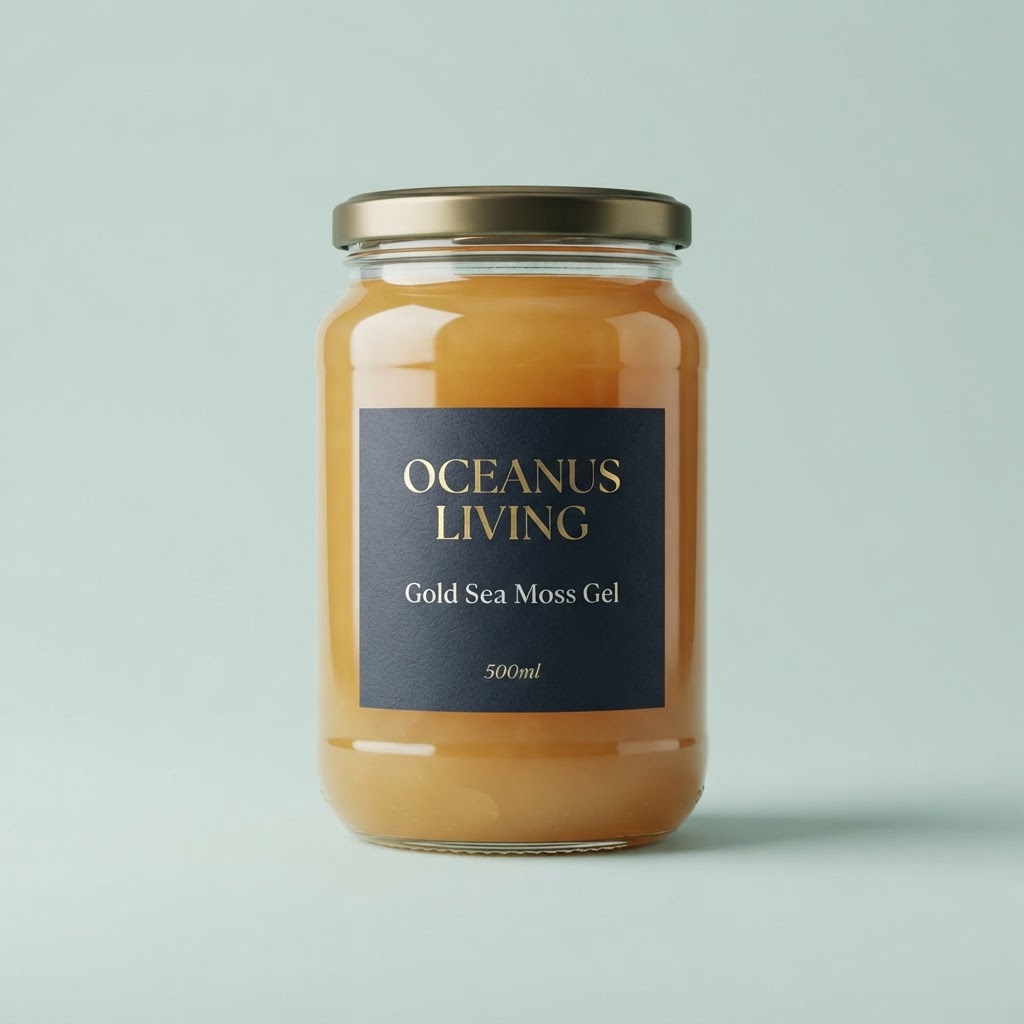
St Lucia Sea Moss Gel, 500ml
Ready to use, prepared in Kent and tested for heavy metals and iodine every batch.
View the gelFrequently Asked Questions
Related
[FOUNDER NAME]
Written and reviewed by the Oceanus Living team for accuracy and UK compliance.
Last updated 25 August 2026
This article is for general information only and is not medical advice. Food supplements should not replace a varied, balanced diet and healthy lifestyle. Oceanus Living products are not intended to diagnose, treat, cure or prevent any disease or condition. If you are pregnant, breastfeeding, taking medication, have a thyroid condition, or are considering use for a child, speak to a qualified healthcare professional first.