Buying Guides
Reading a Supplement Label in the UK: NRV, Daily Dose and Warnings Explained
What must legally appear on a UK food supplement, what % NRV and the 15% "source of" threshold mean, and the five questions that turn "lab-tested" into evidence.
In this article
Learning how to read supplement labels in the UK takes about ten minutes and saves you a lot of money. The label is the one place a brand is legally obliged to be specific, which makes it far more informative than the product page. Here is what has to be there, what the numbers mean, and which claims are permitted — plus how to test whether "lab-tested" means anything at all.
The mandatory statements on a UK food supplement
Certain things must appear on a food supplement sold in the UK. If any are missing, that tells you something about the business behind it.
- The words "food supplement" — the legal category name, not a marketing description.
- The name of the product and the names of the nutrient or substance categories it contains.
- The recommended daily portion, stated clearly.
- "Do not exceed the stated dose" or equivalent wording.
- "Food supplements should not be used as a substitute for a varied, balanced diet and a healthy lifestyle."
- A statement to keep out of reach of young children.
- Net quantity of the pack.
- The amount of nutrients or substances per recommended daily portion, with % NRV where one exists.
- A best-before or use-by date and a batch or lot code.
- Storage and use conditions, where relevant.
- The name and address of the food business operator responsible for the product, in the UK.
- Allergen information, where any of the regulated allergens are present.
That last one matters more than people realise: a UK address means a UK business that can be contacted and held responsible. A product with only an overseas address and no UK operator has nobody accountable to you.
What NRV means, and where 15% comes from
NRV stands for Nutrient Reference Value: a reference figure used for labelling, so that "300µg" means something to a shopper. For iodine the NRV is 150µg a day. It is a labelling benchmark for the general adult population, not a personal target and not a maximum.
So "% NRV" on a label answers one question: how does the amount in this daily portion compare with that reference figure?
The 15% rule is where it becomes useful. To describe a product as a "source of" a nutrient, the product must contain a significant amount of it — generally at least 15% of the NRV per daily portion for a supplement. Below that threshold, a brand may not call it a source of that nutrient at all, however prominently the ingredient is featured on the front.
This is the quickest way to see through a long ingredients panel. A product listing twenty nutrients at 2% NRV each is legally not a source of any of them.
Why "source of" and health claims are regulated
Two different things get regulated, and it is worth separating them.
Nutrition claims describe what is in the product: "source of", "high in", "low in". These are only permitted when the composition thresholds are met.
Health claims describe a relationship between a nutrient and the body, and only claims on the GB register may be used, in wording that keeps their authorised meaning. For iodine, the authorised claims are that iodine contributes to normal thyroid function, to normal cognitive function, to normal energy-yielding metabolism, to the maintenance of normal skin, and to the normal functioning of the nervous system. A health claim may also only be used where the product actually provides a significant amount of that nutrient.
Two consequences worth internalising. Authorised claims attach to nutrients, not to plants or extracts — so a claim about iodine may be made about the iodine in a seaweed product, but the seaweed itself cannot be credited with anything. And no food supplement may claim to prevent, treat or cure disease. Any product page that reads like a list of conditions is outside the rules, and a business willing to break the claims rules is not one whose purity assurances mean much.
Batch codes and best-before dates
The batch code is the most underrated thing on any label. It ties your specific pack to the day it was made, the raw material it came from, and any testing carried out on it. Without it, a recall is impossible and a test certificate is meaningless.
So the question to ask is not "do you test?" but "can I see the results for this batch code?"
On dates: best before concerns quality and applies to shelf-stable products, while use by concerns safety and appears on perishable, chilled foods. Fresh sea moss gel is a chilled food with no preservatives, so it carries a use-by date, plus after-opening guidance and a storage instruction. A gel sold for cupboard storage with a long life has either preservatives or heat treatment behind it — read the ingredients to find out which.
What "lab-tested" should mean
"Lab-tested" is not a regulated phrase. Anyone can put it on a website, and a badge is not evidence. Five questions turn it into something real:
- Which batch was tested? The answer should match the code on your pack.
- Is every batch tested, or was it tested once? One certificate from a single shipment does not describe later stock.
- Was the finished product tested, or the raw material? For a gel, testing dry moss tells you about the seaweed, not about a serving of what you bought.
- What was actually tested for? A report covers only the tests requested. For seaweed you want the four heavy metals — lead, cadmium, mercury and arsenic — and iodine.
- Can I see the certificate of analysis? It should name the product, batch, date, methods and results, and arrive without a fuss.
A brand that answers all five in one reply is a different proposition from one that sends you a graphic.
Our label, line by line
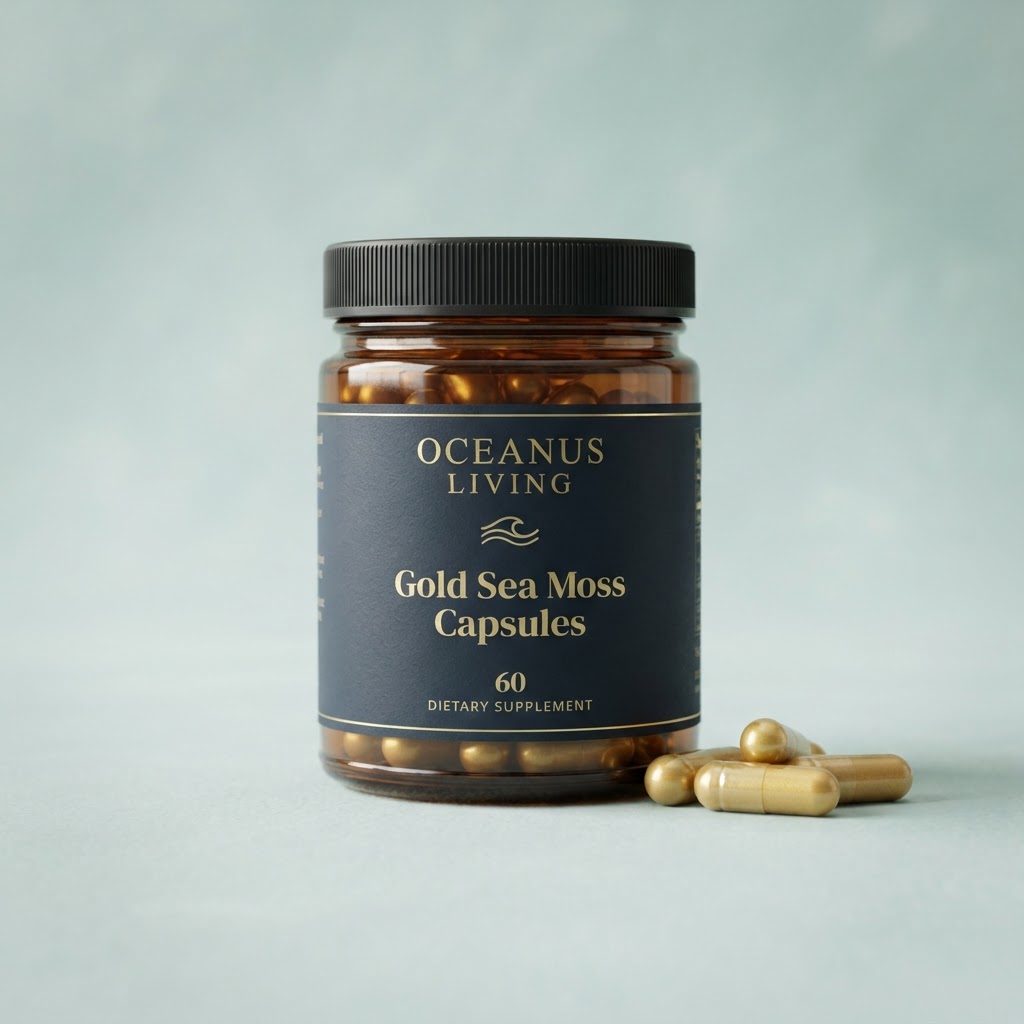
Our gel jar carries: the words food supplement; the ingredients — sea moss ([SPECIES], ocean-grown on lines in St Lucia), spring water, lemon, lime, cinnamon; the serving size of 2 tablespoons (30g) a day; iodine per serving in micrograms with its % NRV for that batch; the batch code and the test date; the use-by date and after-opening guidance; keep refrigerated; do not exceed the stated dose; the varied-and-balanced-diet statement; keep out of reach of young children; a warning to speak to a doctor or pharmacist if you have a thyroid condition, take thyroid medication, or are pregnant or breastfeeding; and our UK food business operator name and address. Our capsules carry the equivalent, with the daily dose stated on the label and each capsule containing 1000mg of dried moss.
We do not print a universal iodine figure across all jars, because iodine varies with species, water, season and processing. We test the finished gel batch by batch and publish the result against the batch code, so the number on your jar is the number for your jar.
Check yours on the Lab Results page, and if you would rather have an exact dose with no measuring, the 60-capsule pack states its daily dose on the label.
Oceanus Living
Shop lab-tested sea moss
Gel, capsules and raw St Lucia sea moss. Subscribe and save 10%.
Shop all productsFrequently Asked Questions
Related
[FOUNDER NAME]
Written and reviewed by the Oceanus Living team for accuracy and UK compliance.
Last updated 25 August 2026
This article is for general information only and is not medical advice. Food supplements should not replace a varied, balanced diet and healthy lifestyle. Oceanus Living products are not intended to diagnose, treat, cure or prevent any disease or condition. If you are pregnant, breastfeeding, taking medication, have a thyroid condition, or are considering use for a child, speak to a qualified healthcare professional first.